


Metal profiles naturally expand as they heat up and contract as they cool down. If adjoining profiles are installed without enough space between them, they can press against one another as temperatures rise. This can lead to misalignment, affect the finished appearance, and even cause loud cracking or popping noises as the metal moves.
The correct expansion gap allows each profile to move freely as temperatures change, helping to maintain both the appearance and performance of the installation.
The required gap depends on four factors:
- The profile material (aluminum or stainless steel)
- The profile length
- The profile temperature during installation
- The maximum temperature the profile is expected to reach after installation
As a general rule, longer profiles and larger temperature changes require larger expansion gaps.
How do you calculate the correct gap between profiles?
Follow these steps to determine the correct expansion gap:
- Identify whether the profile is aluminum or stainless steel.
- Confirm the profile length.
- Measure or estimate the profile temperature during installation.
- Determine the highest temperature the profile is expected to reach.
- Locate those temperatures in the appropriate expansion gap table.
- Read the recommended gap where the installation temperature and maximum temperature intersect.
Example: Suppose you’re installing a 5,000 mm aluminum profile when its temperature is 10°C, and the profile could later reach 70°C. You should leave a 7 mm expansion gap between adjoining profiles.
What gap does a 2,500 mm aluminum profile need?
Use the following measurements for a 2,500 mm aluminum profile:
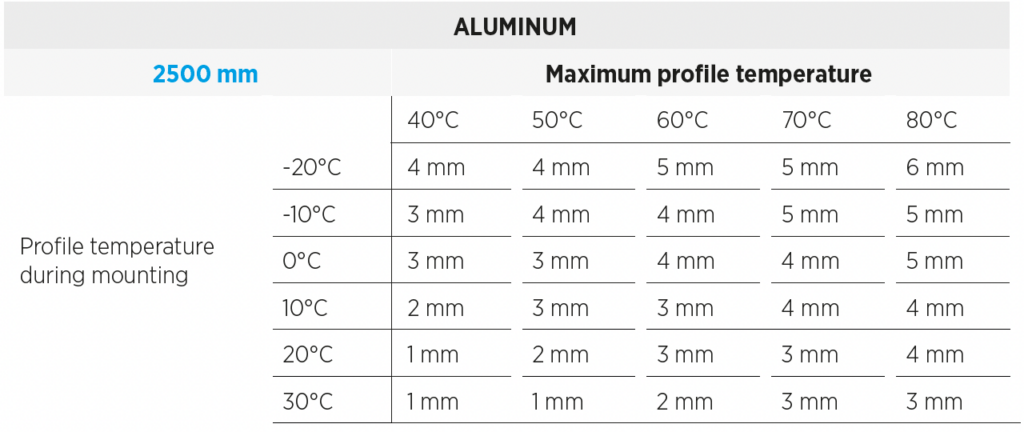
A 2,500 mm aluminum profile requires a gap of between 1 mm and 6 mm under the conditions shown in the ONLEVEL chart.
Example: If the profile is 20°C during installation and could reach a maximum temperature of 60°C, leave a 3 mm gap.
What gap does a 5,000 mm aluminum profile need?
Longer aluminum profiles require more room for thermal movement.
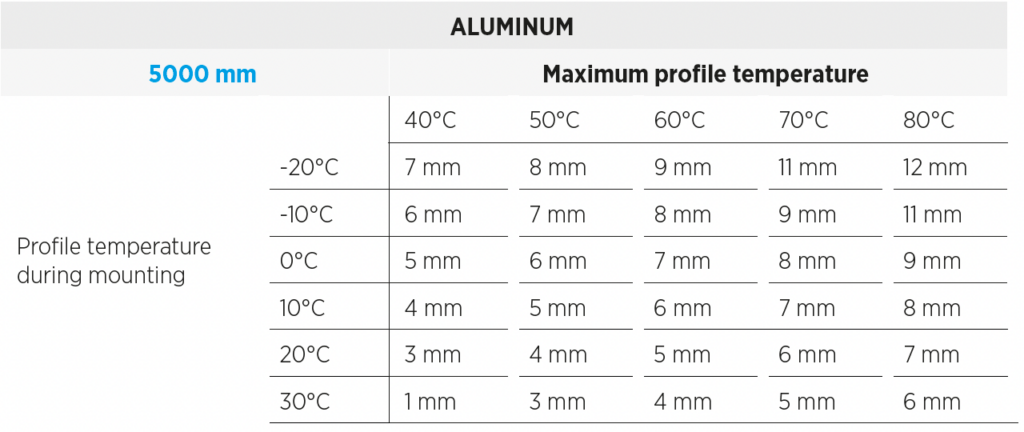
For a 5,000 mm aluminum profile, the recommended gap ranges from 1 mm to 12 mm.
Example: A 5,000 mm aluminum profile installed at 0°C and expected to reach 80°C needs a 9 mm gap. By comparison, the same profile installed at 30°C requires a 6 mm gap if its maximum temperature will still be 80°C.
What gap does a 4,000 mm stainless steel profile need?
Use the following table for a 4,000 mm stainless steel profile:
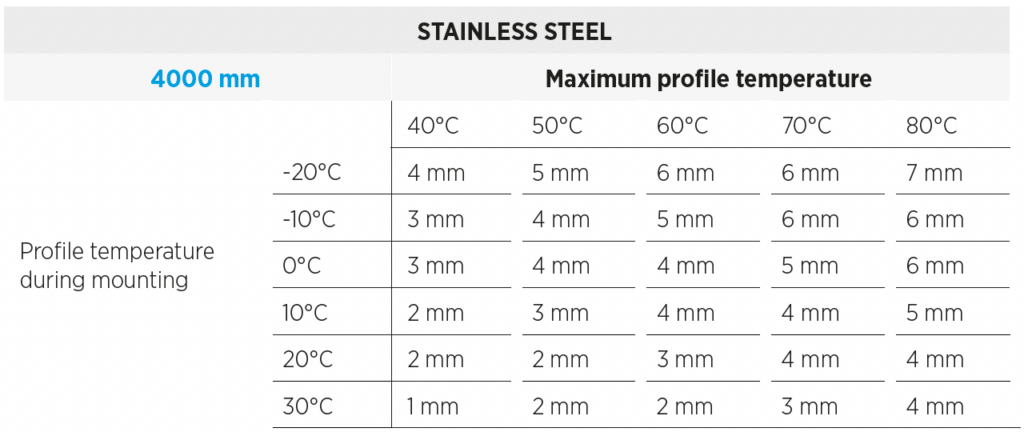
The recommended gap for a 4,000 mm stainless steel profile ranges from 1 mm to 7 mm.
Example: If the stainless steel profile is 10°C during installation and could reach 70°C, leave a 4 mm gap.
What gap does a 6,000 mm stainless steel profile need?
For a 6,000 mm stainless steel profile, use these measurements:
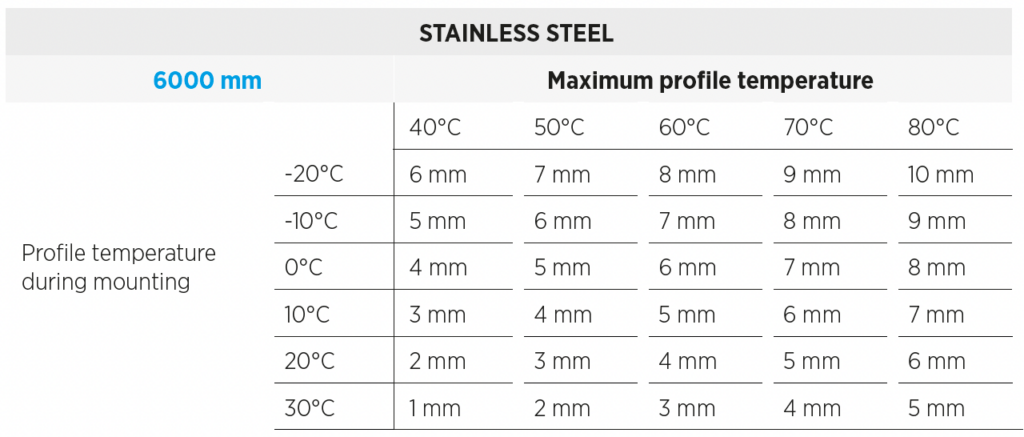
A 6,000 mm stainless steel profile requires a gap of between 1 mm and 10 mm within the listed temperature range.
Example: A profile installed at -10°C and expected to reach 60°C needs a 7 mm gap.
Common mistakes when calculating expansion gaps
Using the outdoor air temperature instead of the profile temperature. The chart refers specifically to the profile temperature during installation. A metal component stored in direct sunlight, in a cold vehicle, or inside a heated building may not be the same temperature as the surrounding air.
Ignoring the maximum expected profile temperature. A profile installed on a cool day may become much hotter in direct sunlight. Your gap should account for the maximum temperature the profile itself may reach.
Using the wrong table. Do not apply the measurement for one material or profile length to another. The source provides separate guidance for:
- 2,500 mm aluminum profiles
- 5,000 mm aluminum profiles
- 4,000 mm stainless steel profiles
- 6,000 mm stainless steel profiles
Assuming a longer profile needs the same gap. Profile length materially affects the recommended spacing. At an installation temperature of -20°C and a maximum profile temperature of 80°C, the chart specifies:
- 6 mm for 2,500 mm aluminum
- 12 mm for 5,000 mm aluminum
- 7 mm for 4,000 mm stainless steel
- 10 mm for 6,000 mm stainless steel
Always match the gap to the actual material, length, and temperature conditions of your installation.
Leaving the correct expansion gap is a simple but important part of a successful installation. By allowing metal profiles to expand and contract naturally, you can help prevent movement, noise, and alignment issues over time.
To determine the correct gap, always consider the profile material, length, installation temperature, and maximum expected operating temperature. Using the correct ONLEVEL table for your specific profile ensures you provide enough room for thermal movement while maintaining a professional, long-lasting installation.