


If you’re specifying a glass balustrade, one of the first challenges is defining the correct design loads. Get this wrong, and you risk failed compliance checks, redesigns, and costly project delays.
So, what line load applies to your balustrade? And when do you need to consider wind load?
In most projects, this confusion happens early, especially when key details are still undefined.
To determine the correct loading requirements, you only need three pieces of information.
The 3 Key Questions That Define Load Requirements
Before calculating anything, answer these three questions:
1. Is the balustrade internal or external?
This determines whether wind load applies.
- Internal balustrades are designed for:
Horizontal barrier (line) load, Glass safety and impact requirements, No wind load - External balustrades must also resist:
Wind pressure acting across the glass surface
Because wind acts over the full panel area, it can sometimes govern the design over line load, particularly on exposed or elevated buildings.
2. What is the occupancy category?
This defines the line load (horizontal load applied at the top of the barrier).
A line load represents the force from people leaning or pushing against the balustrade and is defined in EN 1991-1-1 (Eurocode 1).
The required load depends on building use:
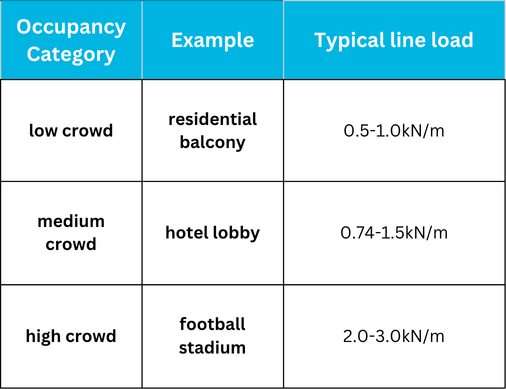
These values are indicative ranges only.The exact design load must be taken from the relevant National Annex, which defines the values used in each country.
3. Which country is the project located in?
Eurocodes provide the framework, but National Annexes define the actual values used in design.
These include:
- Line load values
- Wind pressure values
- Safety factors
As a result, the same balustrade design may require different loads depending on location.
Together, these three answers define the load requirements for the majority of glass balustrade projects.
How Wind Load Is Determined (External Balustrades Only)
For external systems, wind load is calculated using EN 1991-1-4 (Eurocode 1 – Wind Actions).
Wind pressure depends on:
Primary factors
- Building height
- Terrain (urban, open, coastal)
- Exposure to wind
Secondary factors
- Geographic location
- Local wind climate
- Position on the building (edges, corners, roof levels)
Wind load typically increases with:
- Height above ground
- Exposure to open terrain
- Location at building edges or corners
Example:
- High-rise coastal balcony → high wind load
- Sheltered courtyard → lower wind load
Typical wind pressures for balustrades are often in the range of 0.5 to 1.5 kN/m², but this should be treated as an indicative guide only. Actual wind loads must be calculated based on the project conditions and the applicable National Annex.
Wind loading is project-specific and often requires structural engineering input.
What Information You Need to Define Loads
To answer the three questions and define loads accurately, you need:
- Project location (country and wind exposure)
- Internal or external application
- Building use category
- Height above ground
- Surrounding terrain
- Balustrade system type (e.g. frameless, base-fixed)
Providing this information early allows loads to be defined correctly and helps avoid redesign later.
How to Get Glass Balustrade Loads Right First Time
Determining the correct loads for a glass balustrade does not need to be overly complex, but it does require the right inputs from the outset.
By clearly defining whether the balustrade is internal or external, identifying the applicable occupancy category, and confirming the relevant National Annex, you establish the foundation for all loading requirements. From there, project-specific factors such as height, exposure, and terrain allow wind loads to be accurately assessed where required.
When these elements are considered early in the design process, the risk of under-design, compliance issues, and costly redesign is significantly reduced.
Taking a structured approach to load definition ensures that glass balustrade systems are not only compliant, but also efficient, appropriate and fit for their intended application.