


Still spending hours realigning glass after installation? You’re not the only one. If every project feels like a constant struggle with tolerances, shimming, or post-install fixes, you know how quickly that drains your time and margin. Especially under pressure from site managers or clients.
This article is built on the real frustrations of installers just like you. That feedback led to a new kind of system. One that adapts to the glass instead of forcing the glass to adapt to it.
You’re about to discover how switching to this approach can save you hours, eliminate alignment issues, and increase your profit margin. Without sacrificing safety or precision.Some Traditional Glass Railing Systems can Waste Your Time and Margin
If you’ve ever said or thought one of these, you’re not alone:
- “Why do I always need to shim or adjust glass after install?”
- “Why can’t we plan the installation with accuracy?”
- “We lost hours because the glass mounting wasn’t forgiving.”
These issues typically stem from traditional clamp-style base channels that require:
- Multiple correction steps
- Backside access for tightening
- Improvised workarounds to absorb glass tolerances
The result? You lose time, precision, and margin.
How Turboflex Solves the Biggest Glass Railing Pain Points
Turboflex was designed with a different mindset:
“Let the system adapt to the glass position, not the other way around”
As the team behind Turboflex, ONLEVEL developed this system based on direct feedback from thousands of installers. We’ve benchmarked it against every major competitor in real-world conditions. The performance gains are proven on-site.
With Turboflex, you:
- Adjust the glass itself
- Avoid post-install corrections
- Use just one simple tool: the torque tool (with extension)
- Mount and align from the user-facing side only, no scaffolding required
- Snap components into place with pre-mounted fixings
- Fixing only with one screw
It’s faster, safer, and engineered to work the way installers like to work, precise and fast.
Is TURBOFLEX Really Faster?
Yes! And we’ve got the data to back it up.
In benchmark testing across multiple job sites:
- Standard clamp-based systems installation times vary widely because clamps depend on alignment, manual adjustment, and individual installer skill. That makes it impossible to guarantee a fixed time per panel.
- TURBOFLEX changes that. Every panel averages just 3 minutes, and those minutes add up to major time savings across an entire project.
And since you’re working from the safe side:
- No scaffolding = reduced cost and liability
- Smaller crew needed
- Less equipment = more profit and flexibility
Precision That Pays Off
TURBOFLEX delivers full control: both vertically and horizontally.
- No stress points on the glass
- Built-in tolerance absorption for glass thicknesses from 15 to 21.52mm
- Rigid alignment maintained even under high loads
The rubber seals follow the angle of the glass, meaning you get:
- Seamless visual transitions
- No gaps
- No awkward field fixes
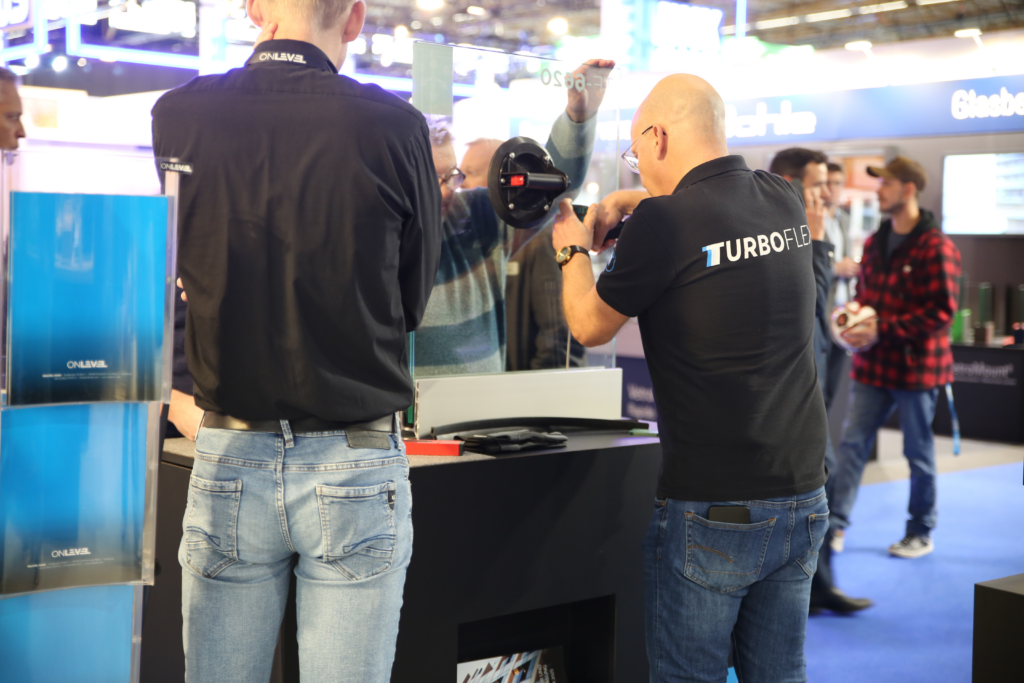
t’s fully plannable for project managers and engineered to be easy for installers to use. This means you can precisely estimate installation time and plan the rest of the day more efficiently. As one of our client says:
“ Thanks to Turboflex, what normally takes an entire afternoon took just 15 minutes. Instead of wasting hours installing glass, we were already back at the office.”
(MVA Monaco)
And with no rework or adjustments needed, the job is truly done the first time.
But I’m Used to My Current System… Why Should I Change?
You might be thinking:
“I’ve got my process dialed in with Q-Railing, Bohle, Glassline, or another system. Why switch?”
Fair question. We get it. What’s familiar is what we tend to stick to.
But here’s the reality regarding glass balustrade systems:
- Familiar ≠ Efficient
- Every minute saved per install = higher margin
- Every avoided rework = a happier client
- Every faster quote = one more job won
You don’t have to change everything. But you do owe it to your bottom line,and your team,to know when there’s a smarter tool for the job.
That’s why we created a full comparision guide to help you choose the right system based on project type, mounting method, and installation preferences.
And, while we are excited about the performance of Turboflex it’s not always the best fit for each project. Read this article about the 5 scenarios in which Turboflex might not be right for the job.