


When choosing a glass balustrade system, the biggest red flags are unclear certification data, testing performed only under ideal conditions, no discussion of project-specific load requirements, unusually low pricing, and no early assessment of the supporting substrate. These issues can affect safety, compliance, installation complexity, structural performance, and total project cost.
How can you tell whether two glass balustrade systems that look similar are truly equal in safety, compliance, and long-term performance? When comparing glass balustrade systems, it can be difficult to see the technical differences behind the glass and profile. Two systems may look almost identical, yet differ significantly in how they were tested, what loads they can support, how they must be anchored, and which substrates they are suitable for.
Many buyers focus primarily on appearance or price, only to discover these differences later in the project. By that point, they may lead to installation delays, structural modifications, compliance concerns, additional costs, or increased project liability. At Onlevel, we work closely with architects, installers, and project teams across Europe to evaluate structural glass balustrade systems for residential developments, hotels, commercial buildings, stadiums, and public spaces.
One thing we consistently see is that the quality of a balustrade system is determined not only by its visible components, but by the engineering behind the complete installation, including the tested configuration, required line and wind loads, anchoring method, and supporting substrate.
Because Onlevel designs and supplies structural glass balustrade systems, we naturally have a point of view on what strong engineering documentation should include. However, the warning signs in this article apply regardless of which manufacturer or supplier you are evaluating.
In this article, you will learn five red flags to watch for when comparing glass balustrade systems: unclear tested configurations, certification based only on ideal laboratory conditions, no confirmation of project-specific loads, unrealistically low pricing and a failure to assess the substrate.
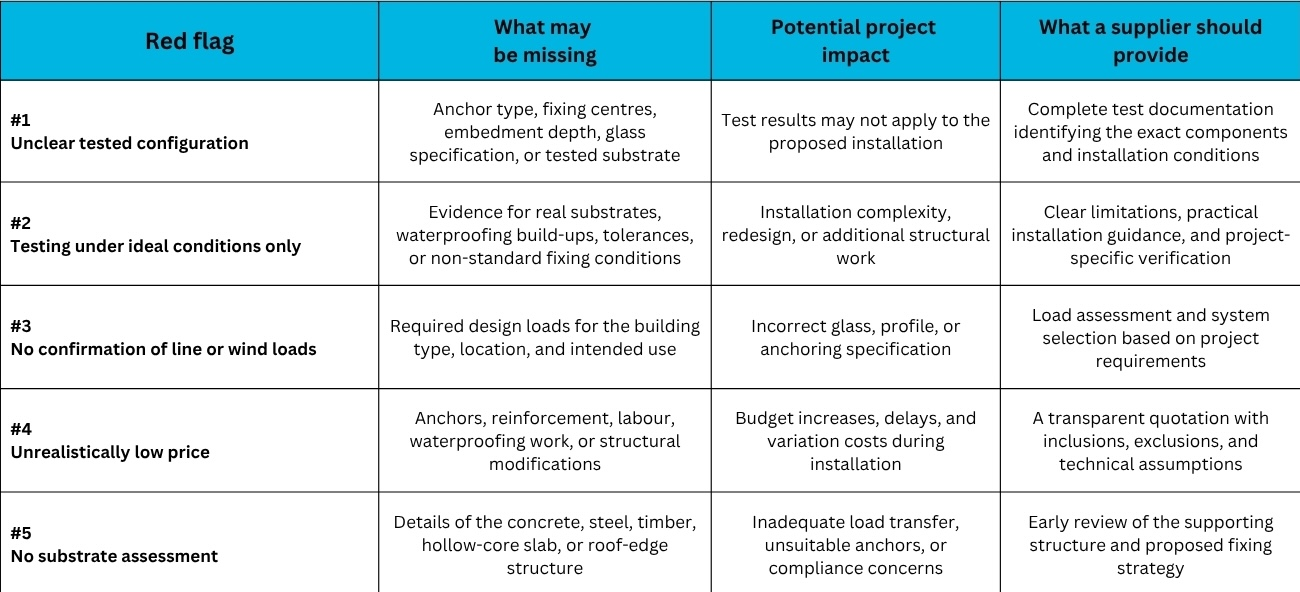
Recognizing these warning signs can help you select a system that is safer, more compliant, and better suited to the real conditions of your project.
Red Flag #1: The Supplier Cannot Show the Exact Tested Configuration
This is one of the biggest warning signs in the industry. Some suppliers promote impressive certification values or maximum load capacities, but do not clearly explain:
- which anchors were used,
- under which conditions the system was tested,
- what substrate was used,
- or whether those testing conditions are realistic for actual projects.
That matters because the anchor is part of the structural system. The performance of a glass balustrade depends not only on the profile and the glass, but also on how loads are transferred into the building structure.
Changing: the anchor type, spacing, embedment depth or substrate, can significantly change the performance of the system.
For example, a system tested with a specific anchor type, spacing, embedment depth, and reinforced-concrete substrate may not perform in the same way when installed into hollow-core slabs, steel edge beams, or waterproofed roof build-ups.
If your project uses different anchors, different fixing centres, or a different supporting structure, you should not assume that the published test results apply without further verification. The proposed installation may fall outside the configuration covered by the test report, certification, or technical assessment.
This is why transparent engineering documentation matters. A supplier should be able to show exactly which components and conditions were tested, explain the limits of the documented performance, and identify when project-specific calculations, additional testing, or a revised fixing solution may be required.
Red Flag #2 :The Certification Was Tested Only Under Ideal Conditions
Not every project has perfect concrete and ideal installation conditions.
Real-world projects often involve:
- different substrates,
- waterproofing layers,
- insulation,
- steel structures,
- hollow-core slabs,
- roof edges,
- and installation tolerances.
The substrate is the structure the balustrade is fixed into, such as concrete, steel, timber, or a roof edge.
Some systems perform very well in laboratory conditions but become significantly more complicated when applied in practical construction environments.
A reliable supplier should be able to explain:
- how the system behaves in real installation scenarios,
- what limitations may exist,
- and what modifications may be required for different project conditions.
A strong test result alone does not guarantee a simple or reliable installation on your project.
Red Flag #3: The Supplier Does Not Confirm Your Required Line Loads or Wind Loads
Load requirements are one of the biggest factors affecting both safety and price. Different project types require different structural performance according to building regulations.
For example: residential projects, hotels, public buildings, stadiums and commercial spaces; often require completely different load capacities.
In many exterior applications, wind load can even become the governing factor. If a supplier focuses only on aesthetics or price without discussing loads, that should raise concerns.
Because the required load directly affects:
- glass thickness,
- profile selection,
- anchoring,
- anchor spacing,
- and overall structural performance.
Without understanding your project loads, it is impossible to properly engineer the balustrade system.
Red Flag #4. The Price Seems Unrealistically Low
A lower price does not always mean a lower total project cost. In some cases, cheaper systems require: additional reinforcement, more expensive anchors, extra labor, waterproofing adjustments or structural modifications later in the project.
Sometimes important technical details are simply excluded from the original quotation.
The result is that unexpected costs appear during installation, when changes become more expensive and time-consuming to solve.
A transparent supplier should clearly explain:
- what is included,
- what is excluded,
- and what assumptions were made during the quotation process.
An incomplete quotation can create major technical and financial problems later in the project.
Red Flag #5: The Supplier Does Not Ask What Substrate the Balustrade Will Be Fixed Into
The substrate is one of the most important technical factors in any balustrade installation. Concrete, steel, timber, hollow-core slabs, insulated facades, and roof edges all behave differently under load. Without understanding the substrate, it is impossible to properly evaluate:
- anchor performance,
- load transfer,
- installation feasibility,
- and compliance with regulations.
If nobody asks about your substrate conditions early in the process, the technical evaluation is incomplete.
The substrate directly affects whether the system can safely achieve its required performance.
The Most Important Question Is Not “What Does It Cost?”
The most important question is not simply, “What does this system cost?” It is:
“Is this glass balustrade system properly engineered for my specific project conditions?”
You now know that a system’s performance depends on more than the appearance of the glass or profile. Certification details, required loads, substrate conditions, anchor specifications, and the tested configuration all affect whether the completed installation will be safe, compliant, and reliable.
Before comparing prices, confirm:
- The required line and wind loads
- The substrate the system will be fixed into
- The exact configuration covered by the test documentation
- The proposed anchor type, spacing, and embedment
- Any installation limitations or additional structural requirements
Taking these steps early can help you avoid unsuitable specifications, unexpected installation costs, compliance issues, and last-minute changes. If you are evaluating a glass balustrade system for an active project, your next step is to confirm these technical conditions before selecting a product or accepting a quotation.
Contact us sales@onlevel.com for project-specific guidance on load documentation, tested configurations, anchoring requirements, substrate conditions and system selection.